
Evidence: What a Breach Actually Costs a Firm
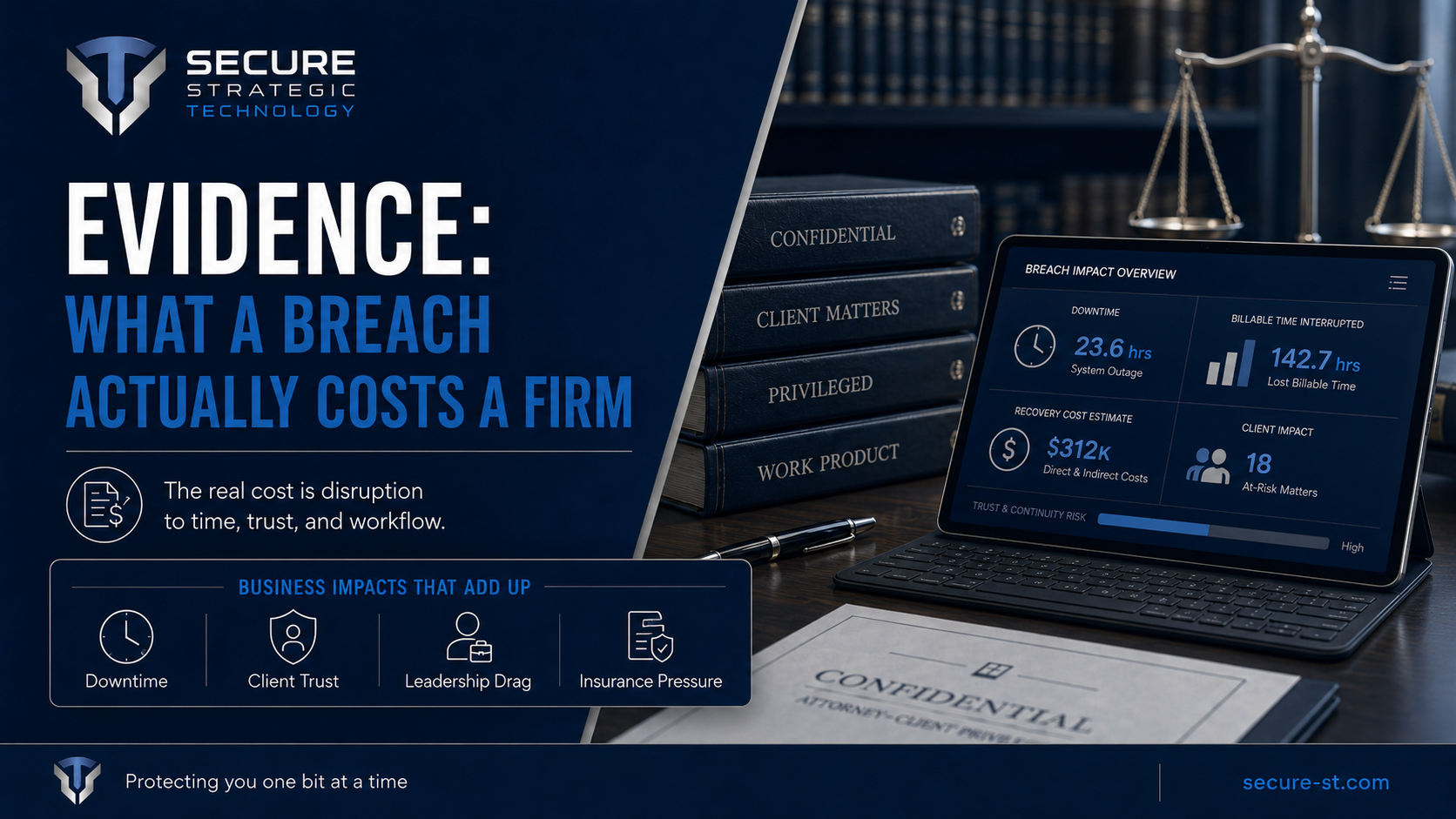
When law firm leaders hear the phrase “cost of a breach,” many picture direct recovery expenses. They think about emergency response, outside expertise, legal review, or system restoration. Those costs matter, but they rarely tell the full story. In a law firm, a breach affects time, trust, workflow, and decision-making across the entire business. The most significant cost is often not the first invoice after the incident. It is the disruption that continues to spread after the event begins.
A firm runs on momentum. Attorneys need uninterrupted access to files, calendars, email, research tools, and communication channels. Staff need predictable systems to support intake, billing, docketing, and document handling. When that rhythm breaks, the financial impact is immediate. Billable time is interrupted. Internal coordination slows. Routine work becomes manual. Even a short disruption can trigger a chain reaction across deadlines, client expectations, and internal workload.
That is why downtime is one of the most underestimated costs of a breach in a legal environment. If attorneys cannot access key files or staff cannot trust core systems, productivity drops fast. Recovery is not just about restoring servers or accounts. It is about restoring confidence that work can continue safely. A law firm may technically be “back online” before it is operationally normal. That gap matters.
Client trust is another major cost center. Law firms are expected to safeguard highly sensitive information. Clients assume that privileged communications, litigation documents, financial records, and strategic discussions are handled with care. When a breach occurs, the question is not only what was accessed but also whether the firm appears in control. Clients want evidence that the firm understands the incident, can contain it, and is taking disciplined action. If leadership struggles to provide clarity, confidence drops. Even if a client relationship is not lost immediately, future work and referrals may be affected.
Internal response costs also expand quickly. A breach demands leadership attention. Partners, firm administrators, finance leaders, and operations staff all get pulled into response decisions. Time that should go toward growth, client service, and internal management gets redirected into containment, communication, and documentation. This leadership drag is easy to overlook because it does not always show up as a line item. It still carries real cost.
Insurance and compliance pressures add another layer. Carriers increasingly expect law firms to demonstrate controls such as MFA, secure backups, oversight of privileged access, and repeatable processes. After an incident, those expectations do not disappear. They become even more urgent. A firm may face tougher renewal conversations, additional scrutiny, or a more burdensome validation process. Even when coverage remains available, the operational effort required to support those conversations increases.
There is also the cost of remediation by accumulation. Following a breach, many firms rush to buy tools. They add monitoring, email filtering, identity controls, or awareness training under pressure. Some of those investments are necessary. The problem is that reactive buying often creates overlap, inconsistency, and added complexity. Without a roadmap, the firm spends money but still lacks a defensible operating model. In that scenario, costs rise while clarity does not.
The better way to think about breach costs is in terms of business impact. How much billable work is interrupted? How long does recovery actually take? How much leadership time is consumed? How much client confidence is placed at risk? How prepared is the firm to answer questions from insurers, auditors, or clients with confidence? Those are the metrics that make the issue real.
This is also where better security changes the equation. A firm with controlled access, protected backups, documented recovery steps, and regular reviews is not immune to incidents. It is simply in a stronger position to contain them. Recovery is faster. Decision-making is clearer. Client communication is more credible. Insurance conversations are more straightforward. The business remains more stable under pressure.
A breach is costly because it exposes every weak point at once. For law firms, the lesson is not just to spend more on security. It is to build a more structured environment before an incident forces the issue. That is the evidence leadership should focus on. Better security protects more than systems. It protects continuity, credibility, and the ability to continue serving clients when conditions are at their worst.