Busy Season Confidence Comes From Verification, Not Hope
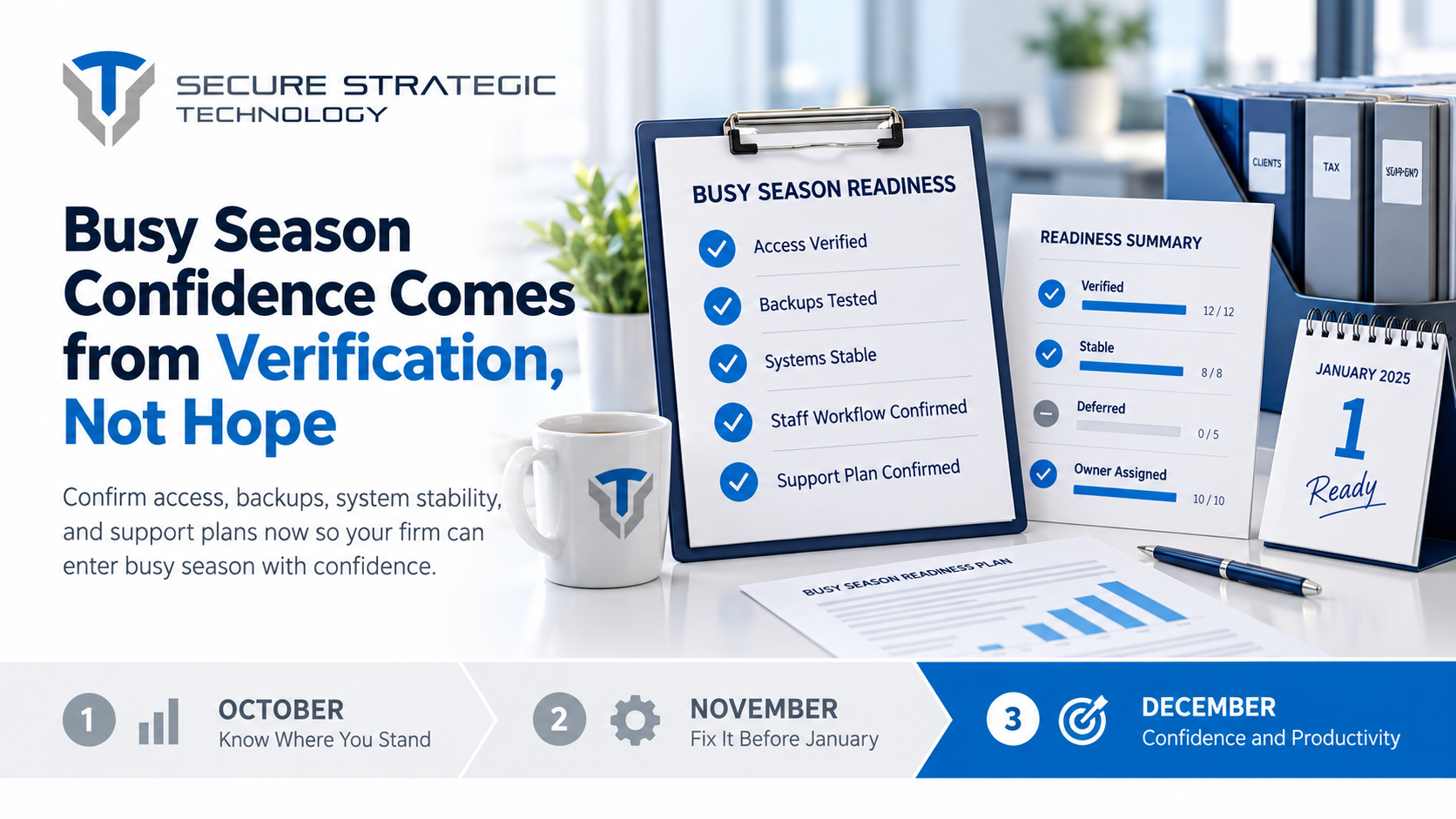
December is not the month to keep adding changes to the technology environment. It is the month to verify that the work completed in October and November has produced a stable, supportable foundation for busy season.
For accounting firms, readiness is not an abstract cybersecurity goal. It is the ability for staff to sign in, reach the systems they need, work without repeated interruption, and recover quickly if something goes wrong.
That confidence should come from verification, not hope.
Start with access.
Confirm that multi-factor authentication is working where required, stale accounts have been removed, privileged access is limited, and third-party access is understood. Staff should know how to get help if they are locked out, and leadership should know who can approve urgent access changes.
Then verify backup and recovery.
Critical systems and data should be protected. Backup failures should be monitored. Recovery responsibilities should be clear. Where appropriate, restore validation should provide evidence that data can be recovered. Busy season is the wrong time to discover that a backup process was incomplete or that nobody knew who owned the recovery decision.
System stability is next.
Required patching and updates should be complete. Known critical issues should have owners. Recurring endpoint or application problems should be resolved where possible. At this point, the firm should also identify a practical change freeze for nonessential work. Stability is a feature during peak season.
Staff workflow deserves equal attention.
Technology readiness is not complete if the infrastructure looks healthy but employees continue to lose time to slow logins, unstable remote access, printing problems, application delays, or repeated device issues. Review the recurring complaints surfaced in October and the fixes made in November. Confirm that the improvement is real from the user’s perspective.
December is also the time to review incident responsibilities.
If a critical system becomes unavailable, who makes the business decision about priorities? Who contacts SST or another vendor? Who communicates with staff? How will leadership receive updates? What is the fallback if a primary workflow is unavailable?
The objective is not to write a massive incident-response manual in December. It is to make sure the people involved know their roles and can act without wasting time figuring out ownership during an interruption.
Finally, give leadership a concise readiness view.
A one-page summary can show what was assessed, what was remediated, what was verified, what remains open, and what has been intentionally deferred until after busy season. That level of visibility supports better decisions and reduces last-minute surprises.
SST’s service-delivery model is built around proactive management, standards alignment, strategic planning, and clear business outcomes. Those principles fit busy-season preparation because they shift the conversation away from individual tools and toward operational resilience.
The goal for December is not perfect technology.
The goal is a verified and stable environment that supports the people doing the work.
When January arrives, accounting teams should be focused on clients, deadlines, and billable work rather than avoidable technology problems. Leadership should know that access is controlled, recovery is understood, major gaps have been addressed, and the support path is clear.
That is what readiness looks like.
Assess in October. Repair in November. Verify in December. Then enter busy season with confidence.