Busy Season Starts Before January: Know Where Your Technology Stands
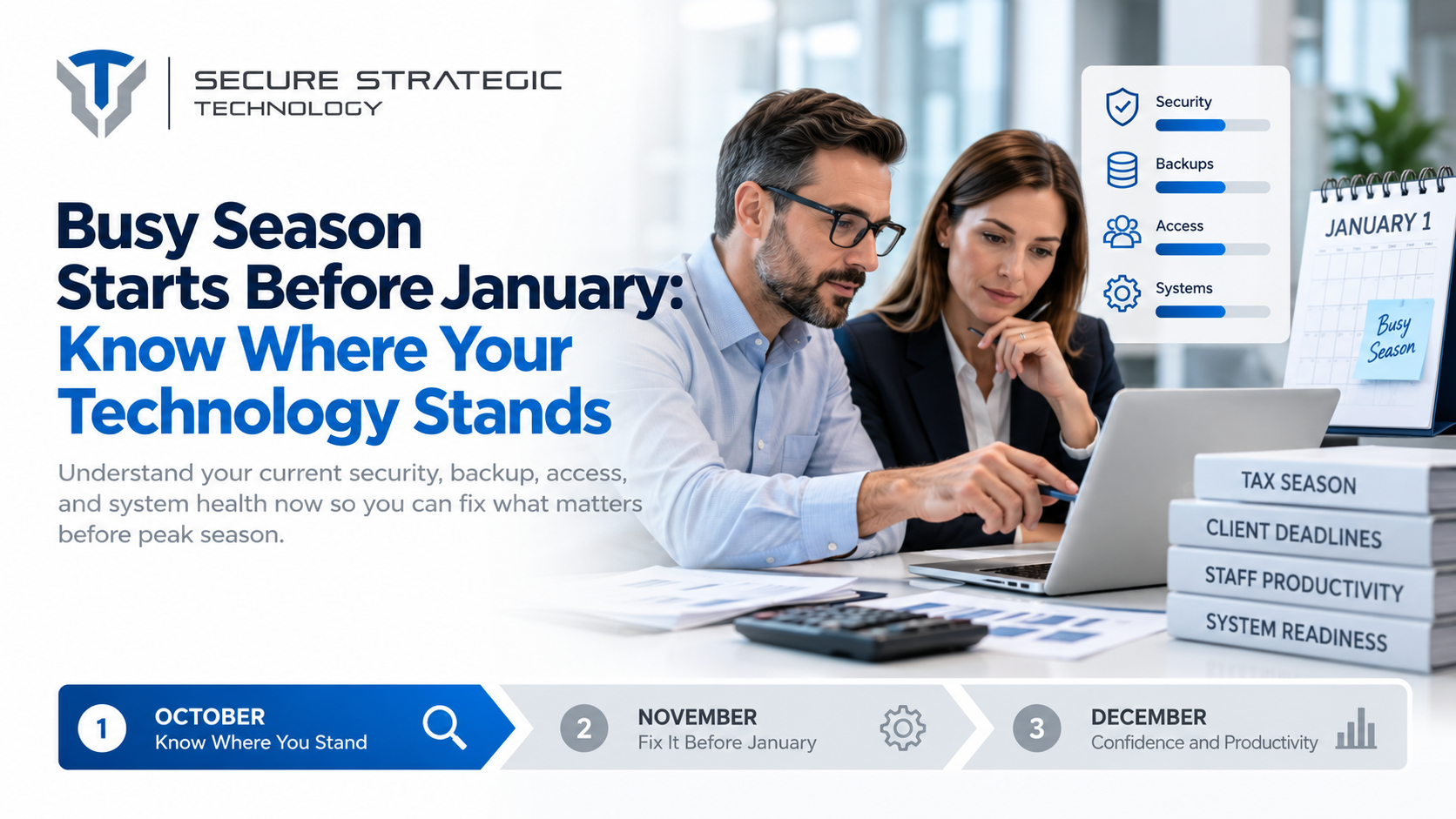
Busy season rarely exposes a technology problem that appeared overnight. More often, January puts pressure on issues that were already there: inconsistent access controls, unverified backups, aging systems, recurring application problems, or small workflow delays that staff have learned to work around.
For accounting firms, those issues matter because peak season changes the cost of interruption. A login problem in October is frustrating. The same login problem when calendars are full, client deadlines are tight, and every hour matters becomes a business problem.
That is why October should be the baseline month.
The goal is not to change everything at once. The goal is to understand the current state clearly enough to decide what must be fixed before January.
Start with security posture. Leadership should know whether multi-factor authentication is consistently enforced for critical systems, whether former employee access has been removed, whether privileged accounts are limited appropriately, and whether third-party access is controlled. A firm can have good security tools and still carry risk if access is inconsistent or poorly governed.
Next, look at backup and recovery. It is not enough to know that backups exist. The firm should know what is being backed up, whether failures are monitored, what recovery expectations exist for critical systems, and whether recent restore testing has confirmed that the process works. During peak season, recovery confidence matters more than assumptions.
Then look at the everyday technology experience. Accounting teams often normalize recurring friction: slow logins, printing problems, unstable remote connections, application delays, repeated password issues, or devices that require frequent attention. Individually, these problems may seem minor. Across an entire team, they can create repeated interruptions exactly when the firm needs consistent productivity.
October is also the right time to review how technology decisions are governed. Does leadership have a clear view of open risks? Is there a current written information security plan or documented security process? Are technology priorities reviewed on a recurring basis? Is there a defined owner for incident response, recovery decisions, and vendor coordination?
A useful baseline should produce three things.
First, it should separate assumptions from verified facts. “We have backups” is an assumption until restore testing confirms recovery. “We use MFA” is incomplete until leadership knows where it is enforced and where it is not.
Second, it should prioritize issues by business impact. A cosmetic inconvenience should not receive the same urgency as an access-control gap, unreliable recovery process, or recurring problem that interrupts client work.
Third, it should create a realistic remediation list for November. Busy season is not the time for broad technology changes. October gives the firm time to identify what needs attention while there is still room to act.
SST’s approach centers on proactive maintenance, cybersecurity, strategic planning, and disciplined process. A business and technical assessment can give leadership a clearer view of the environment and help convert scattered concerns into a practical roadmap.
The objective for October is simple: know where you stand.
When leadership has visibility into security, recovery, access, and workflow friction, November can be used to make focused improvements instead of guessing. That creates a much stronger path into December, when the question shifts from “What is wrong?” to “Are we ready?”